It’s Time to Take Avoidable Costs Out of Healthcare




Healthcare affordability is one of the defining challenges of our lifetime.
The pressures that impact affordability are changing constantly. Costs continue to rise. Administrative complexity continues to grow. Healthcare leaders have to make bigger decisions, faster, in an environment that’s harder to interpret and harder to predict. And the ultimate sufferer is usually the patient who relies on an inefficient system.
For too long, the industry has treated cost as a downstream problem to manage after care has been delivered — something to audit, dispute or optimize once it has already shown up in the system. That approach has fallen short on lowering the cost of healthcare.
Solving the healthcare affordability issue and bringing financial relief to patients requires a better approach: the ability to understand cost earlier, see cost drivers more clearly, and act before administrative friction compounds.
That’s the shift healthcare needs now.
Cost intelligence drives affordability gains
The real opportunity in front of healthcare is to improve decision-making before care is delivered. That requires healthcare leaders to ask different questions: What drives cost variability across markets, populations, and settings of care? How do network options, pricing factors, clinical decisions, and payment cycles interact? Where can action be taken earlier so downstream friction is minimized? And most importantly, how does the industry work together to improve the patient experience?
These aren’t compliance questions. They’re strategic ones. Organizations that can answer them are in a stronger position to improve performance, reduce unnecessary administrative burden, and create a better experience for both the organizations and the patients, who expect healthcare to operate efficiently.
That includes payers managing affordability pressure, employers designing smarter benefits, providers navigating margin and reimbursement realities, and policymakers looking for ways to reduce friction without compromising access or quality.
You can’t fix what you can’t see
As a CFO, I know all too well that cost pressures can arise unexpectedly across an entire organization. Healthcare costs aren’t created in one place, and they aren’t owned by any one stakeholder. They take shape across contracts, care decisions, benefit design, networks, reimbursement models, site-of-care choices and market dynamics. They’re influenced by clinical realities, administrative workflows, and financial incentives that don’t always move in the same direction.
That’s why affordability can’t be solved through raw data or isolated point solutions.
If leaders don’t have true visibility into what’s driving costs up, they’re left reacting to symptoms instead of addressing causes. Better insights across the healthcare ecosystem can help turn data into the actionable information needed to improve performance.
That means alignment between the finance team and all business units that moves toward surfacing cost intelligence that leaders can actually use — insight that explains what’s happening, why it matters, and where action will have the greatest effect.
Cost control is a reaction. Cost understanding is a strategy. It’s the difference between identifying an issue after it occurs and making a better decision, early enough to change the outcome.
Innovation that meets the specific needs of healthcare
As we focus our energy on driving affordability and using price transparency data to make better decisions, we can’t ignore the impact of emerging technology and AI tools.
The pace of AI advancements is putting pressure on leaders to move quickly, but we must also be disciplined about how that technology is applied. Automation without explainability can accelerate the wrong action. And AI without governance can introduce new risks into a system that’s already strained.
In a high-consequence environment like healthcare, innovation must be practical, governed, and worthy of trust. Responsible AI isn’t separate from performance. It’s part of what makes performance sustainable at scale. Our team is leading the way with a strategic framework for responsible AI in healthcare that creates a solid foundation and the governance demanded by both our internal and external stakeholders.
It requires commitment, investment, cross-functional alignment, and strategy. But I have full confidence in our approach and am thankful for the experts leading these efforts at Claritev. We’re proving that you can be both boldly innovative and fiercely protective at the same time.
Clarity in action
At Claritev, we believe the path forward hinges on making healthcare costs visible across the ecosystem.
That takes more than tools. It takes technology, data, workflow integration and deep domain expertise. It takes responsible AI embedded in the right places. And it takes a cross-functional understanding of how cost, care, operations, and market behavior connect.
Claritev is especially well positioned to help because we work across the healthcare ecosystem. Our strategy is grounded in the objective transparency and purposeful innovation required to drive affordability in healthcare. Not just to improve isolated workflows. Not just to support compliance. Not just to analyze what already happened. But to help healthcare leaders act earlier, with greater confidence, and with a clearer understanding of what it’ll take to make the system work better for everyone.
When costs are explainable, decisions become understandable, disputes decline and the system moves faster with less friction. That’s where meaningful affordability gains begin — not by shifting cost from one stakeholder to another, but by removing avoidable cost and unnecessary complexity from the equation altogether.
Related Content
New ideas, proven best practices, and fresh perspectives for the healthcare ecosystem.
-
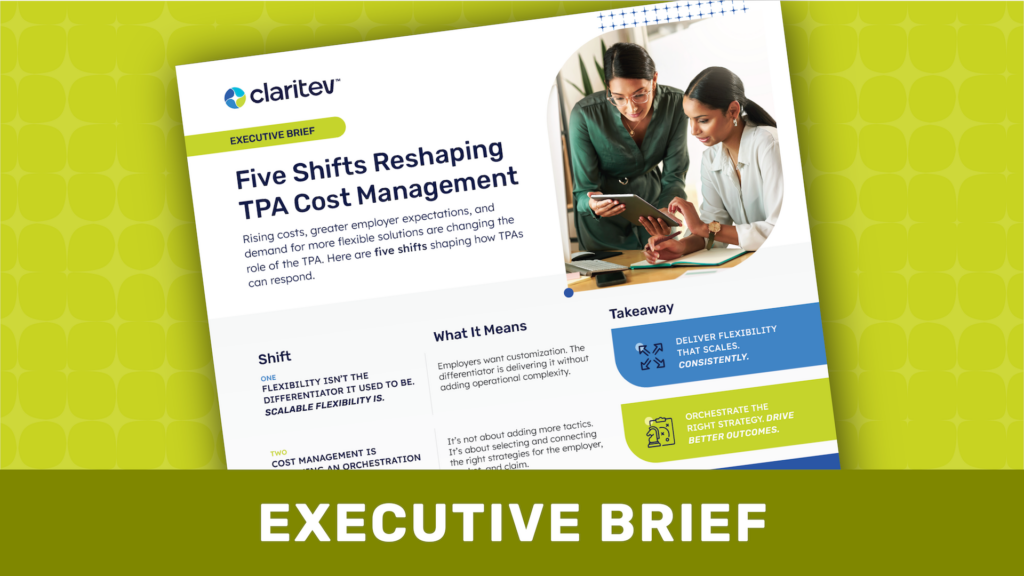
Five Shifts Reshaping TPA Cost Management
Our Executive Brief explores five shifts reshaping TPA cost management and what they could mean for TPAs looking to strengthen their role with employers.
Read More -

The Fountain of Youth in Healthcare is Fostering an Innovation Mindset
What keeps a 45-year-old healthcare company innovative in a rapidly changing market? Learn how strategic investment, operational agility, and actionable insights help organizations navigate…
Read More -
The Operational Value of Healthcare Pricing Intelligence
Healthcare transparency data offers significant potential, but turning it into actionable insights requires the right strategy. Learn how healthcare pricing intelligence helps organizations improve…
Read More