Strategic guide
The Operational Value of Healthcare Pricing Intelligence
Healthcare transparency data offers significant potential, but turning it into actionable insights requires the right strategy. Learn how healthcare pricing intelligence helps organizations improve decision-making, cost management, and network performance.

Publicly available transparency data creates visibility, but operational barriers, including reimbursement structures, contract timing, market dynamics, and data inconsistencies, still prevent many organizations from turning raw pricing information into actionable intelligence.
The path to advancing operations from data access to strategic decision-making can be explored with this three-part framework:
- Part 1: Assessing the evolving policy landscape
- Part 2: Navigating the complexity of transparency data
- Part 3: Innovating for real-world benefits
PART 1
Assessing the evolving policy landscape
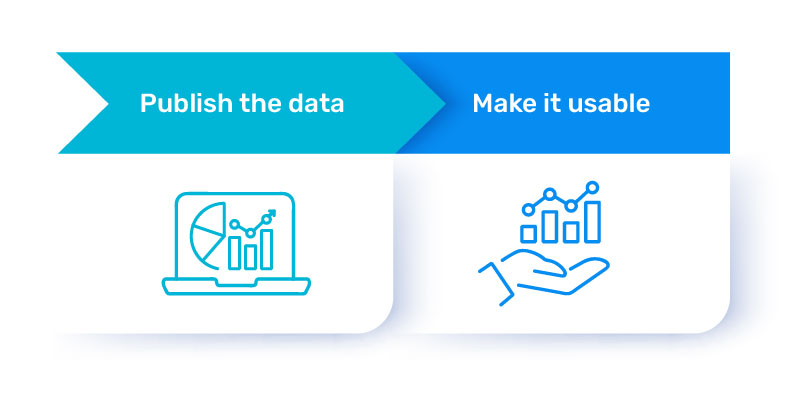
Over the past several years, price transparency policies have introduced major industry shifts with regulations like Transparency in Coverage (TiC) and healthcare price transparency regulations. It has moved from “publish the data” to “make it usable,” with stronger enforcement, monthly payer machine-readable file (MRF) updates, annual hospital updates, and momentum to expand and codify rules.
Leaders should keep a forward-looking perspective on emerging legislative developments, specifically the Patients Deserve Price Tags Act, which is set to expand pricing requirements to incorporate ambulatory surgical centers (ASCs) into transparency mandates. This legislation is anticipated to close existing gaps in the transparency landscape. As these ASC datasets become available, organizations will gain greater visibility into lower-cost sites of care, creating new opportunities to support steerage strategies, evaluate network performance, and improve healthcare cost management.
As transparency policies evolve, so does the importance of understanding the impact to intelligently enhance healthcare affordability and accessibility. One essential step to harnessing transparency’s power lies in the analytical refinement of the raw data that populates these machine-readable files (MRFs).
Without contextualization, organizations risk making flawed comparisons and misinformed strategic decisions. Prepare for evolving policy and regulations now by establishing a strong foundation in data management and interpretation.
PART 2
Navigating the complexity of transparency data
Healthcare transparency has created vast datasets, including hospital price transparency (HPT) files and TiC health plan machine-readable files (MRFs). These datasets provide a wealth of information but require a nuanced understanding to be truly valuable.
MRF datasets are often massive, inconsistent, and difficult to interpret without significant structured analysis. Organizations must account for differences in reimbursement methodologies, outdated records, coding inconsistencies, and varying publication timelines before the data becomes operationally useful. This becomes an even higher strategic imperative as AI models are implemented across the industry.
Look for these potential data differences:
- Reimbursement methodologies
- Outdated records
- Coding inconsistencies
- Varied publication timelines
In some cases, the same procedure may appear to have dramatically different negotiated rates between hospital and payer transparency files. However, closer analysis may reveal that one figure reflects a base reimbursement structure while another reflects a bundled or percentage-based methodology. Without proper normalization, organizations risk making inaccurate comparisons and flawed strategic decisions.
Importantly, the frequency of data updates also differs significantly, with HPTs requiring annual updates and payer machine-readable files (MRFs) following a monthly refresh. This disparity highlights the need for robust data management strategies to ensure accuracy and relevance.
Mismatched data between hospitals and payers can be resolved through detailed analysis, uncovering hidden patterns that inform strategic decisions. Figure 1 provides a visual depiction of the data normalization process that allows for more strategic and actionable comparisons.
Figure 1: Transforming Raw Data into Actionable Insights
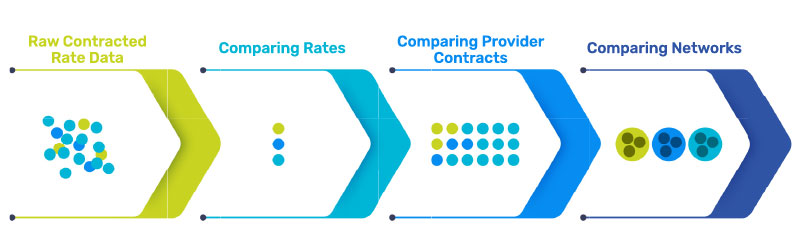
By transforming complex datasets into usable, standardized formats, organizations can extract actionable insights for competitive advantage.
PART 3
Navigating the complexity of transparency data
Transparency policies have created a foundational infrastructure to drive innovation and efficiency across the healthcare ecosystem.
As shown in Table 1, leading healthcare organizations increasingly view transparency not simply as a compliance requirement, but as a strategic planning capability that supports more informed operational and financial decisions.
Tangible examples of value opportunities include earlier visibility into pricing variation, reimbursement trends, and network dynamics which can help support more proactive negotiations, stronger financial forecasting, and more informed healthcare purchasing decisions.
This level of insight supports employers’, brokers’, and TPAs’ ability to engage in more proactive renewal discussions and evaluate network strategies with greater confidence.
Objective transparency data can also help organizations assess provider density, geographic access, and network adequacy using actual contracted pricing information.
Moving from raw transparency data to actionable insights also enables organizations to move beyond traditional discount-based network comparisons. By analyzing actual allowed amounts and contracted provider rates, brokers, employers, and TPAs can gain a more accurate understanding of network competitiveness, reimbursement dynamics, and plan performance.
Analyzing transparency data at scale can surface broader reimbursement patterns. Contract structures tied to Medicare benchmarks or percentage-of-charge arrangements can provide valuable insight into market positioning, negotiation strategy, and network competitiveness.
Table 1: Price transparency gives visibility to all parties across the financial healthcare lifecycle.
Patients
Benefit from price transparency through targeted service and market affordability comparisons resulting in lower premiums, decreased patient cost sharing (e.g., co-insurance and deductible) and higher quality of care
Brokers
Make rapid data-driven decisions that support negotiating better contracts, optimizing networks, and providing stronger customized recommendations to clients
Employers
Deploy cost containment strategies by benchmarking network performance, steering toward high-quality, low-cost providers, optimizing plan design, and negotiating better contracts
Payers
Understand their competitive position, benchmark performance, improve contracting negotiations with providers, optimize networks, and identify high-quality providers
Providers
Assess competitive position, compare rates across contract structures, negotiate confidently with payers, and simulate pricing scenarios to predict revenue impact before implementing changes
TPAs
Identify optimal networks of high-quality, low-cost providers to manage costs and plans more effectively, thereby maintaining strong employer relationships through data-driven insights
As transparency regulations evolve, datasets mature, and innovative technology solutions — including responsible AI models — emerge to simplify industry complexities, the competitive advantage will increasingly belong to organizations that can operationalize pricing intelligence faster and more effectively than their peers.
Looking forward
Healthcare transparency continues to reshape the industry. The onus is on organizations to not only stay compliant but also to leverage innovation to capitalize on the immense potential of transparency data.
Organizations that invest now in data normalization, pricing intelligence, and operational analytics will be better positioned to navigate a challenging healthcare environment, strengthen financial decision-making and engage more proactively in an increasingly competitive healthcare market.
By aligning transparency initiatives with broader decision-making frameworks, organizations can leverage price intelligence to ultimately improve affordability and patient experiences.

Explore healthcare transparency resources
Discover expert perspectives, research, and practical resources to help bring greater clarity to healthcare decisions.
Related Content
New ideas, proven best practices, and fresh perspectives for the healthcare ecosystem.
-

Turning Transparency Data Chaos into Reimbursement Intelligence
Transparency data is transforming reimbursement strategy, but only when it can be trusted and applied effectively. Discover how Claritev turns complex pricing data into…
Read More -
Rethinking Reference-Based Pricing
Reference-based pricing is evolving to meet the demands of rising healthcare costs, shifting market conditions and changing business priorities. This white paper explores how…
Read More -

The Fountain of Youth in Healthcare is Fostering an Innovation Mindset
What keeps a 45-year-old healthcare company innovative in a rapidly changing market? Learn how strategic investment, operational agility, and actionable insights help organizations navigate…
Read More