Turning Transparency Data Chaos into Reimbursement Intelligence



Sean Crandell
General Manager, Claims Intelligence Solutions, Claritev
It all started with the Transparency in Coverage (TiC) rule. Since taking effect, it has changed what the healthcare industry can see. Payers, providers, employers, and their partners have access to a broad view of negotiated reimbursement data across the market.
This visibility gives the industry a new way to understand how reimbursement works across providers, geographies, networks, and service categories. But visibility alone does not create a stronger pricing strategy. In fact, the volume and complexity of machine-readable file (MRF) data can make it difficult to know what is useful, what is reliable, and what can be applied to pricing strategies with confidence.
That is the challenge many organizations are facing. Transparency data has opened the door to new reimbursement opportunities, but without a way to organize, evaluate, and apply that data, potential value can be left on the table. The real opportunity is turning transparency data chaos into pricing strategies organizations can use, explain, and trust.
Why is now the right time to take action on transparency data?
It’s no secret that healthcare organizations are facing increasing pressures to manage reimbursement variation, rising medical costs, and the growing need for explainable payment decisions, all while being asked to do more with fewer internal resources.
That pressure is forcing leaders to rethink how they use available data. Traditional reimbursement strategies still play an important role, but today’s environment requires more ways to evaluate claims, understand market dynamics, and support decisions that can be explained with confidence. This is where leveraging transparency data can start to move the needle.
Used correctly, it can provide a more current view of publicly available reimbursement information. It can help organizations understand reimbursement variation across markets and where additional pricing approaches may create value. It can also support more informed conversations with employers, providers, internal teams, and clients.
But the phrase “used correctly” is important.
Machine-readable files are massive, fragmented, and inconsistent. The same provider may appear in different formats. Rate schedules may include codes that are not relevant to a provider’s actual billing patterns. Some rates may look like valid market signals but are really outliers, ghost rates, or records that do not represent a meaningful reimbursement benchmark.
The industry has access to trillions of transparency records. It needs the ability to interpret and glean intelligence from it for action.
Experience is needed to create clarity
Claritev has spent decades in the network, pricing, and reimbursement space. We understand how rate schedules are built, how reimbursement methodologies are applied, and how network pricing decisions show up in real claims workflows.
That experience matters because transparency data cannot simply be lifted from a file and applied to a claim. It needs to be filtered, standardized, matched, localized, and evaluated through a methodology that understands both the data and the market it represents.
We have found a way to make this data actionable by combining AI-enabled data standardization with Claritev’s pricing and reimbursement expertise. That means filtering out incomplete records, ghost rates, and other unreliable pricing signals, then using the right data to provide reimbursement insights supported by clear rationale. This new, innovative approach gives organizations a market-informed tool for today’s out-of-network reimbursement challenges.
The result is the ability to use the right data, in the right way.
Clarity in Action
No single pricing methodology should have to fit every claim scenario.
Employers, payers, and TPAs have different goals, plan designs, markets, and member considerations. One scenario may call for a network-based strategy. Another may require reference-based pricing or negotiation support. That is why having more tools in the reimbursement toolkit delivers better results and greater value.
Leveraging price transparency data made available by the TiC rule for your out-of-network reimbursement strategy will not replace every approach already in place. It does give organizations another way to evaluate claims, apply market-informed intelligence, and support pricing decisions with greater clarity.

Ready to move beyond data access to actionable reimbursement intelligence?
By combining transparency data with AI-enabled standardization and Claritev’s pricing and reimbursement expertise, Transparency-Based Pricing gives organizations a market-informed tool for today’s out-of-network reimbursement challenges.
Related Content
New ideas, proven best practices, and fresh perspectives for the healthcare ecosystem.
-
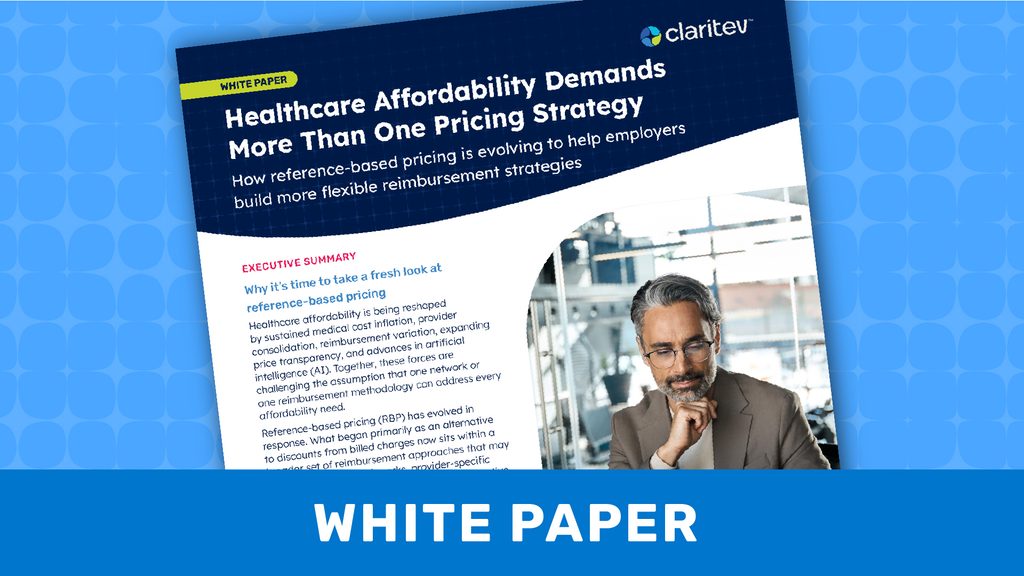
Rethinking Reference-Based Pricing
Reference-based pricing is evolving to meet the demands of rising healthcare costs, shifting market conditions and changing business priorities. This white paper explores how…
Read More -
The Operational Value of Healthcare Pricing Intelligence
Healthcare transparency data offers significant potential, but turning it into actionable insights requires the right strategy. Learn how healthcare pricing intelligence helps organizations improve…
Read More -

The Connection Between Better Decision-Making and Healthcare Affordability
Healthcare affordability and access are often viewed as competing priorities—but they don’t have to be. By leveraging data-driven insights, network strategy, and greater price…
Read More