The Cost of an Empty Plate

Andrew Lounder, Ph.D.
Director, Claritev Cares
It’s hard to think about a regular checkup when you aren’t sure how you’ll provide tonight’s dinner.
That’s the quiet truth behind a lot of what we see in healthcare. People tend to take on the big, forward-looking things, like preventive care, a conversation about blood pressure, or addressing an as-yet mild ailment, only after the basics are covered. When the plate is empty, everything else waits. And when everything else waits, the bill eventually comes due, often in an emergency department and often at a much higher cost to the person and to the system.
I’d like to offer a different way to think about the impact of hunger. Feeding people isn’t only goodwill. It is foundational to the healthcare infrastructure.
Why an empty plate is a health issue
Before joining Claritev, I spent about 20 years in education, where there’s a familiar shorthand for this idea: Maslow’s hierarchy of needs. It’s a simple framework to understand human behavior that might not otherwise seem rational. People only address higher-order needs, like preventative healthcare, once more basic needs are secure. Parents don’t seek medical care if that money needs to go towards their kids’ breakfast.
To me, the hidden cost of hunger is bigger than a line item. It’s our collective humanity and human potential, and at the most fundamental level, it’s about people’s health. When a household is stretching to cover food, chronic conditions get harder to manage, care gets delayed, and small problems have a propensity to grow.
That’s the thinking behind “Food as Medicine,” one of Claritev Cares’ four charitable programs. It’s a direct extension of Claritev’s mission to make healthcare more affordable, transparent, and accessible. It’s hard to make care accessible for someone who is struggling to put food on the table.
Where the idea becomes tangible
The national conversation about food as medicine can feel abstract. But taking action to provide meals to people in your community is tangible. Claritev associates have joined Tango Charities for meal-prep events held alongside our in-person meetings across the country, putting the idea to work with their own hands. At a town hall in McLean, Virginia, associates prepared about 2,000 meals in a single event.
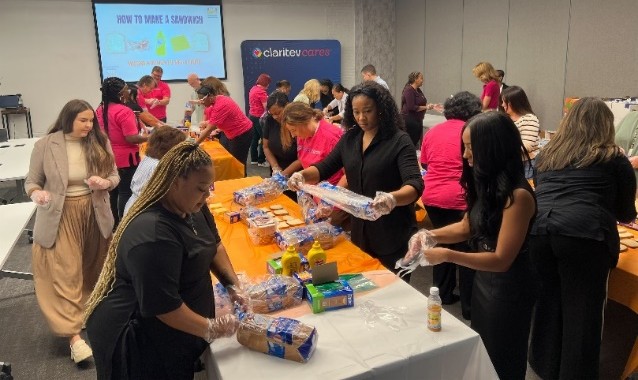
Nick Marino, Tango Charities’ volunteer executive director, says one of the biggest things they’ve learned is that “hunger doesn’t discriminate.” It affects children, veterans, seniors, working families, and people who may appear to be doing just fine from the outside. A medical bill, an unexpected expense, a job loss, or even the cost of everyday necessities like higher gas prices can force a family to make difficult decisions about how they spend their money.
Since Tango Charities launched Feed the City in 2015, the program has prepared and distributed more than 9 million meals, with 135,000 volunteers engaged across 80 cities in 20 states. This September, Feed the Country brought more than 2,100 volunteers together across 70 communities to prepare approximately 55,000 meals in a single day.
Nick puts the stakes plainly for a healthcare audience, “Access to nutritious food affects a person’s ability to learn, work, recover, and live a healthy life. Addressing hunger is an opportunity to make an impact before someone ever needs medical care.”
What the numbers suggest
For benefits leaders, the human story and the financial story point in the same direction, and the news is more hopeful than you might expect.
Food-insecure adults average $1,834 more in annual healthcare spending than food-secure adults, which adds up to an estimated $53 billion in excess U.S. healthcare costs each year. USDA research from 2019 to 2022 points to the health side of that story: stroke, coronary heart disease, diabetes, arthritis, and hypertension were 1.9 to 9.5 percentage points more prevalent among adults in very low food-secure households than in high food-secure ones. Not to mention the toll this grave situation can take on the impacted employee’s focus and productivity.
The encouraging part is what happens when food access improves. A 2026 multi-state evaluation covering more than 1.45 million screened patients, reported in Feeding America’s Food as Medicine 3.0 report, found that connecting food-insecure households to food access programs reduced hospitalizations by 14% and ER visit rates by 11%, while food security improved by nearly 7 points. For high-risk, diet-sensitive patients, medically tailored meal programs have been shown to reduce hospitalizations by up to 49% and overall healthcare costs by 16%.
There’s a practical opening for employers, too. HSAs and FSAs now cover medically approved meal delivery services, which gives benefit leaders a new way to help employees put tax-free dollars toward long-term health. With roughly $170 billion in HSA and FSA buying power, even a small portion directed toward food as medicine could start to make a dent in what the country spends treating late-stage chronic disease.
Built on a tradition, grown through trust
Claritev Cares didn’t start from scratch. When I arrived at Claritev, I learned that the company has a long and storied tradition of giving back, rooted in our old regional offices: diaper drives, Toys for Tots, and more. In their heyday, those volunteer efforts seem to have focused on local hunger more than half the time. That was, and is, the opportunity.
As we shaped our strategy around improving healthcare access, we kept coming back to a simple idea: better health starts with basic needs. That thinking led us to make Food as Medicine one of Claritev Cares’ core areas of focus. Addressing hunger resonated across the Claritev community in 2026, and we see significant opportunity to build on that foundation in the years ahead.
Building trusted relationships is a priority in our inaugural year of Claritev Cares. Tango Charities has become exactly that kind of partner to Claritev Cares. As Nick puts it, “Claritev is not just talking about improving lives; you’re bringing your employees together to take action.”
An empty plate carries a cost that all of us end up sharing. A full one is among the most direct investments we can make in health, and in human potential.

Learn more about Claritev Cares and how to get involved.
Related Content
New ideas, proven best practices, and fresh perspectives for the healthcare ecosystem.
-
Claritev Releases 2025 Corporate Responsibility Report
Claritev’s 2025 Corporate Responsibility Report highlights progress in responsible AI, employee engagement, community impact, and sustainability, reinforcing the Company’s commitment to responsible innovation and…
Read More -

Claritev Cares Helps Rural Patients Get Critical Care Closer to Home
Grants will support portable diagnostic technology in Illinois and continued access to specialist expertise on Kodiak Island.
Read More -
Why Investing in Our Associates Extends to Investing in Their Families
Why Investing in Our Associates Extends to Investing in Their Families Back-to-school season is always full of possibility, and this year, 10 new college…
Read More