Return on Tokens: A CFO and Chief AI Officer’s Playbook for AI Capital Allocation
As AI reshapes every industry, the companies that win won’t be those that use the most AI. They’ll be the ones that understand its value. Discover a practical playbook for AI investment, governance, and ROI from Claritev’s CFO and Chief AI Officer.
Co-authored by:
Doug Garis
Chief Financial Officer, Claritev
Fernando Schwartz, Ph.D.
Chief AI Officer, Claritev
One of the most common questions being asked in boardrooms today is whether AI represents an opportunity or a threat.
We’ve noticed something interesting about that question. Both answers produce the same behavior. Companies that see a threat launch pilots to hedge against an emerging and compounding set of problems. Companies that see an opportunity launch pilots to chase exotic promises of new revenues or dramatic reductions in costs.
Eighteen months later, in most cases, the pilots are still pilots. Whether you framed AI as offense or defense, no one had clear ownership of the investment, and the pressure creates a need to change the way teams plan for AI.
“As a chief financial officer, I was trained to know what a dollar buys. Nobody trained me to ask what a token buys.”
DOUG GARIS, Chief FINANCIAL Officer | Claritev
That question gets at something bigger: AI is no longer a technology experiment. It is a capital allocation and operating-model decision.
This piece is our attempt at an operating answer, written by two of the people who must sign for it. One of us allocates the money spent on AI. The other puts it to work. It is written for companies of any size; the mechanics run the same whether you have two hundred employees or twenty thousand.
PART ONE | Allocate
Operationalizing AI 101: what we are buying and building
There are three kinds of enterprise AI, so far: predictive, generative and agentic. Telling these three apart matters more than the vocabulary suggests. Predictive AI produces scores and forecasts: which customers might churn, which invoices look anomalous. It is well established, often repeatable, and already part of many technology budgets. Generative AI creates content from instructions, whether text, code, or structured data; the output is not inherently deterministic. Agentic AI uses generative AI and tools to take multiple steps toward a goal. It does not just draft an email; it can pull data, draft the email, and file the result. The second and third are where much of the new investment, and confusion, live.
The commercial distinction matters as much as the technical one. Traditional predictive systems are often funded like infrastructure: provision compute and pay for it whether it runs hot or idle. Many generative and agentic services introduce a different meter, more like electricity. Models process information in units called tokens, and providers commonly charge for what goes in and what comes out.
“Priced per million tokens, usage can sound cheap enough to ignore. That’s the trap.”
Fernando schwartz, ph.d., Chief ai Officer | Claritev
Most executives would file the token meter as a technical detail. We think it is one of the most useful financial facts about enterprise AI. When the meter moves with work rather than simply with a server, workflows carry a cost per completed task: cost per invoice, cost per document, cost per claim. Those are numbers finance can audit, budget, and compare with the same work today. A metered service adds variable expense that can rise with adoption and quietly outrun the budget that approved the pilot.
Why: a capital allocation question wearing a technology costume
When the AI conversation reaches the CFO’s office, it stops being a technology conversation. It becomes the oldest discussion in finance: where does the next dollar go, and what should it return?
At Claritev, we run a simple rule. We currently invest about 10% of R&D in AI innovation. We’ll defend the discipline behind that number more than the number itself. That 10% is divided between two buckets with two different clocks: a speculative bucket that’s allowed to fail, and a committed bucket that is intended to show a return inside the fiscal year. From a financial perspective, there is one authority who determines when a project investment terminates.
Why spend on AI at all? Because before you buy anything new, you must know what you already have and aren’t using. Look at your balance sheet honestly, and you may find real value sitting idle: decades of proprietary data nobody queries. Workflows you already paid to build and maintain. Hard-won expertise that lives with a handful of people and never gets past their desks and into code. Assets that are depreciating and IP that is being amortized with much more useful life left.
AI is the first tool in a while that meaningfully raises the utilization of what you already own. It’s less about extracting individual value and more about making what you have available to everyone. The 10% investment is the cost to access all of it and where we start and focus our experimentation dollars.
We believe the discipline matters far more than the percentage allocation. Your number may not be 10%. But this approach transfers to any company at any scale. Not every AI investment should be expected to pay back on the same timetable. Embedded workflow automation should generally demonstrate a return within the fiscal year. Evaluation infrastructure, data foundations, and other capabilities that support multiple use cases may require a longer horizon.
The discipline stays the same: each investment needs a clear purpose, an owner, a way to measure progress, and a defined point at which the business decides whether to continue.
Who: the role of a Chief AI Officer
You need a Chief AI Officer at a specific moment: the moment AI stops being a portfolio of projects and becomes a change in how work is produced. At that moment, the Chief AI Officer is accountable for two things at once: the rate of adoption and the risk posture. That pairing belongs to no one else on the org chart. The Chief Information Officer owns systems, the Chief Digital Officer owns data, and business units own their profit and loss (P&L) statement. Each of them will optimize their own piece, and none of them will own the rate of change across the whole.
It’s equally important to say what the role is not. The Chief AI Officer is not the person who owns the models. Models are components. The role is accountable for the operating system that consumes them.
One way to tell whether AI has become a real enterprise capability is to look at how the AI function works with finance. An AI function that finance cannot audit is a lab. An AI function that finance does audit, with unit costs and payback periods and termination dates, is a capability.
From the income statement, AI looks like a threat to your cost structure. An immediate demand to increase operating expenses. From the balance sheet, it looks like a way to get more out of what you already paid for in your assets and intellectual property. Same technology, different altitude and focus.
PART TWO | Evaluate
Even the frontier model builders keep revising their forecasts
Before we tell you what we know, take notice of what the people building this technology have done with their own predictions.
In 2025, Anthropic CEO Dario Amodei warned that AI could eliminate up to half of entry-level white-collar jobs within five years and drive unemployment into double digits.1 By May 2026, OpenAI CEO Sam Altman was acknowledging that job losses had not arrived as quickly as he expected, saying he was ‘delighted to be wrong.’2 That same month, Amodei described a different mechanism: automation might allow people to spend more time on the portion of a job that remains, multiplying output rather than simply removing the role.3 Goldman Sachs CEO David Solomon was among the leaders arguing that panic was overstated.3 Meanwhile, labor evidence cut in more than one direction. Yale researchers had not found a clear aggregate employment effect attributable to AI, while technology companies were still announcing layoffs and citing AI among several drivers.3,4 These are changing interpretations, not proof that future job displacement will or will not occur.
Read that as a CFO. Two of the people closest to the frontier revised how they described AI’s labor-market implications within roughly a year. If even they are adjusting the forecast, no finance chief should accurately underwrite a five-year plan to a single prediction, including ours. The lesson is not that the forecasters are foolish. It is that a forecast is a poor substitute for an operating model. You don’t make the company depend on one prediction being right. You build an operating model that is cheap to be wrong.
“You don’t make the company depend on one prediction being right. You build an operating model that is cheap to be wrong.”
DOUG GARIS, Chief FINANCIAL Officer | Claritev
What we know
Four lessons have held up in our own production experience, which are both defensible and informative.
Large language models (LLMs) are reliable at bounded tasks with checkable outputs: extraction, classification, drafting against a defined schema. Human review isn’t only a compliance and regulatory safeguard, it’s an accuracy strategy, and the systems that keep people focused on the exceptions consistently outperform the ones that don’t. Proximity beats sophistication, by which we mean a modest model wired into your own data and workflow will usually beat a frontier model bolted on beside them. And governance built before deployment is an investment, where governance built after deployment is remediation at several times the price.
We should be equally plain about the open questions, because pretending to be certain is how companies are negatively impacted, and companies have been wrong before.
We don’t pretend to know the future of software engineering.
If a large share of production code is model generated within a few years, what does an engineering organization look like? What do you hire for? What happens to the team-size-to-throughput ratios underlying technology budgets? We do not know whether agent reliability compounds or plateaus, whether inference costs fall faster than usage rises, or whether AI regulation converges on a common standard or fractures across states. Those unknowns are real, but not reasons to suspend all action.
The timing rules
The unknowns aren’t a reason to wait. The practical answer is to build an investment model that can absorb being wrong. These are four timing rules we use:
- Move versus wait. Move now when the task is bounded, the output is checkable, and errors are recoverable. Wait when a failure is difficult to undo or the workflow itself is about to change. Automating a process you plan to redesign is paving the cow path.
- When a pilot becomes a commitment. Set graduation criteria before the pilot begins: target unit cost, a quality bar against the existing process, a real adoption threshold, and a date. A pilot without a date is not actionable.
- When to stop. End on the agreed termination date if the criteria have not been met, regardless of sunk cost or enthusiasm. Initiatives re-justify themselves from zero at each review rather than rolling forward by incumbency. This is zero-based budgeting applied to innovation.
- When to hire a Chief AI Officer. Too early: a few isolated use cases can still be led from within an existing function. Too late: business units are buying AI independently with no shared risk posture, and the new leader’s first year is archaeology.
The structure that makes these rules runnable is something we call a pod: a small, durable, cross-functional unit with a business owner, a defined outcome, and a termination date. It is the smallest organizational structure that can survive being wrong. Think of it as working-capital discipline applied to innovation. Don’t let capital sit in slow-turning experiments.
The real threat, it turns out, isn’t the technology. It’s underwriting your company to a forecast that even the forecasters keep revising.
PART THREE | Build and Measure
What deployment actually looks like
Companies deploying AI today are working in three tiers: assistive, embedded and autonomous. Understanding which tier you’re in is essential to setting realistic expectations and priorities.
The assistive tier is broad and relatively low risk: drafting, summarization, and searching. Productivity exists here but can be diffuse and hard to measure. The embedded tier is narrower and higher-value: extraction, coding support, routing, and intelligence inside existing workflows with checkable outputs. Much of the most durable near-term ROI lives here. The autonomous tier, where agents act with minimal supervision, is real but belongs only where tasks are bounded, instrumented, and governed, regardless of the market narrative.
At Claritev, our center of gravity is deliberately the embedded tier: documented intelligence inside healthcare claims workflows, where checkable outputs meet meaningful volume.
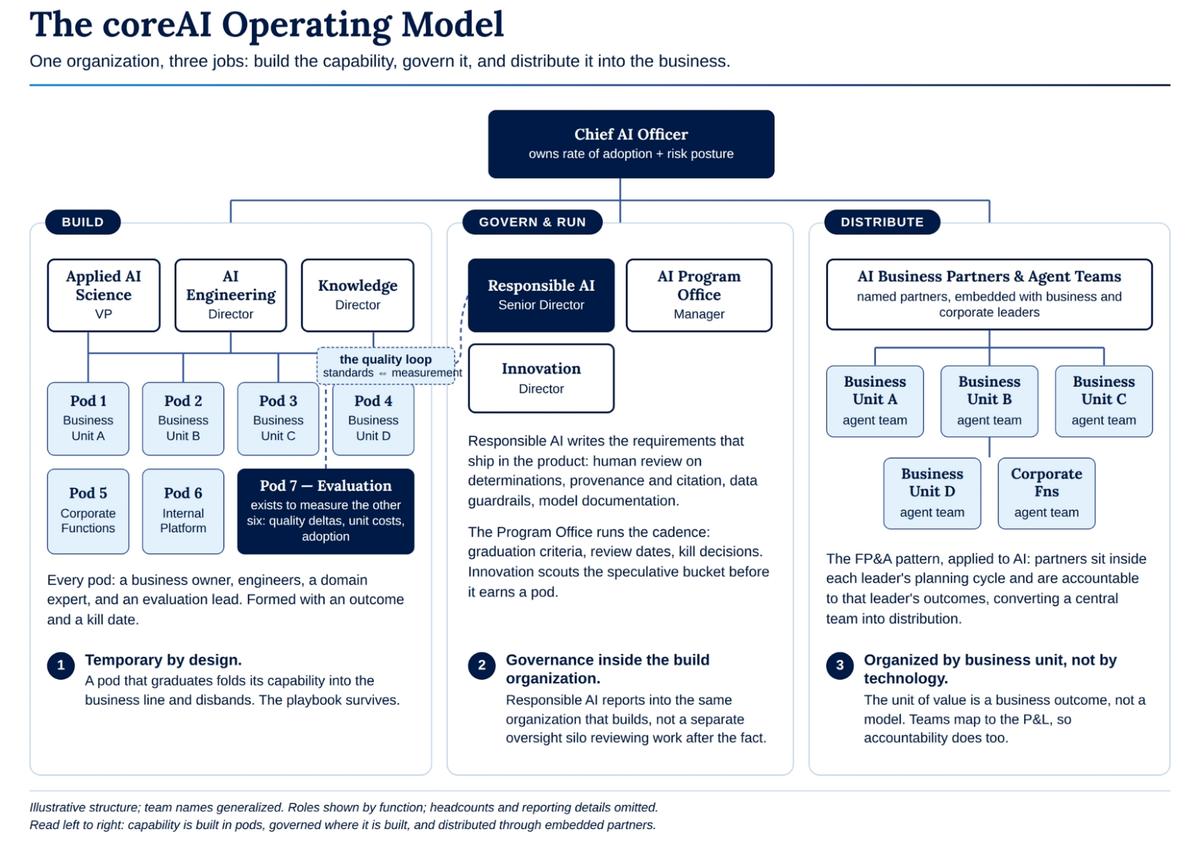
Figure 1 | The core AI operating model: builds capabilities, governs and runs, and distributes them into business lines
Pods in practice
A pod, in our operating model, is five to eight people: a business owner who carries the outcome, engineers, a domain expert, and someone who owns evaluation and quality. The pod owns the process end to end, from definition through deployment through measurement with fewer handoffs, because handoffs are where accountability quietly disappears.
Pods run on a fixed cadence against the graduation criteria set at formation, and there is a practical ceiling on how many you can have at once: run too many and governance may break before delivery does, so we’d rather run a few well than a dozen nominally. Pods are also designed to end. A successful one folds its capability into the business line, disbands, and leaves a playbook behind. The pod is temporary; the capability is what stays.
AI business partners: the new FP&A
AI business partners are the piece of the AI operating model most companies miss, and the one with the deepest precedent in the finance function itself.
Doug: About thirty years ago, finance decentralized itself. Financial planning and analysis (FP&A) grew out of a back-office consolidation function into something new: finance business partners. Analysts were embedded with operating leaders, fluent in the P&L and in the operating reality behind it, with enough executive presence to sit in the room where decisions were actually made. It was an innovation. It worked so well that nobody remembers it was ever an innovation. Today no serious company (small or large) runs without FP&A.
Fernando: What FP&A became to finance, AI business partners are becoming to the AI function. These are named individuals embedded with corporate-function and business-unit leaders, sitting in their planning cycles, accountable to their outcomes. The profile is demanding because it’s a hybrid. Genuine technical sophistication on one side. On the other, the kind of executive-level presence you’d expect from a top-tier consultant: the ability to command a leadership meeting, not just brief it. The embedding is the mechanism that converts a central AI team from a bottleneck into distribution.
Doug: I watched the FP&A transition happen from the inside, and the pattern is consistent. The function earns influence on the day its people stop being a service queue and start being in the room before decisions are made. The model has a real cost. The cost of skipping it is higher. When demand outruns responsiveness, the business routes around the function. Business units stop waiting and find their own solutions, giving way to shadow AI.
At Claritev, we staff AI operating models like this: AI partners paired with corporate and business leaders across our operating units, inside their planning rhythm rather than reviewing outputs after the fact. Chaperoned by FP&A acting on behalf of the CFO office as we allocate capital.
The playbook
None of the above should exist as institutional folklore – it should be real and documented. At Claritev, we maintain an internal playbook covering how a pod forms, how graduation criteria are written, how evaluation is built, and how a capability is handed to the line. The point is that the second deployment should be cheaper than the first, and the tenth should be routine.
Figure 2 | AI playbook: the repeatable rules for forming pods, evaluating models, governing deployment, reporting RPM, and handing capabilities to the line.
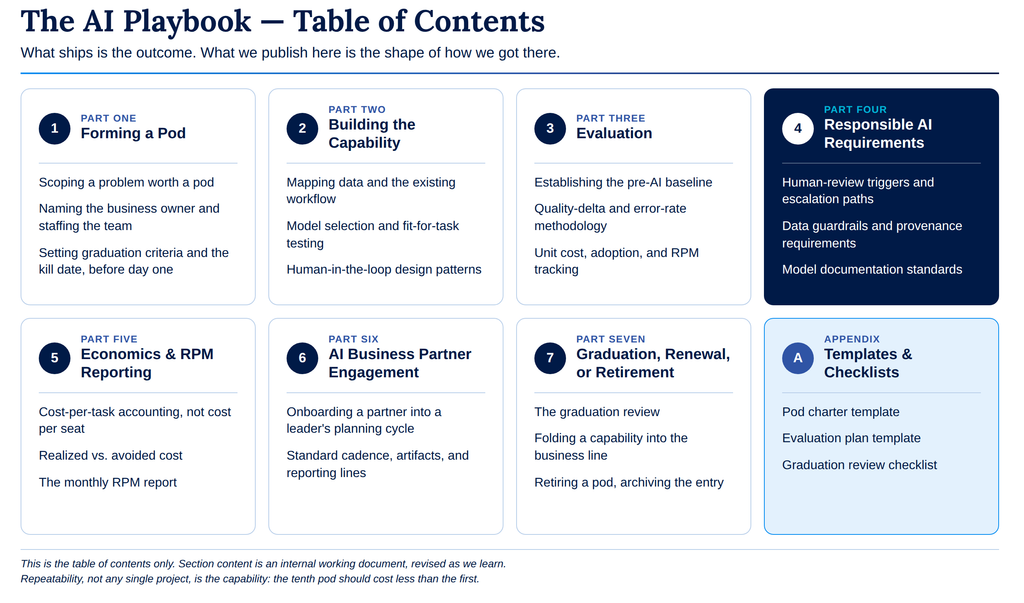
We’d encourage any company to write yours and treat it as a living document. Repeatability is the difference between having done AI projects and having an AI capability.
The CFO’s office: RPM
If you are a CFO, this may be the section you skipped ahead to.
CFOs of my generation grew up on RPMs: revenue per mile if you came up in logistics or transport, revolutions per minute if you came up near a plant floor. Either way, the instinct is the same: useful output per unit of energy. This decade of AI needs its own version of RPM: return per million tokens.
Return per million tokens is the realized value of work completed per million tokens consumed, measured at the task level, against a pre-AI baseline, and counting only outcomes that survive an audit. It’s an effective measure of productivity , but it is not a substitute for dollar-denominated ROI. Finance still has to account for model prices, implementation, human review, rework, and infrastructure.
Why coin this term, RPM? Because the issue isn’t simply whether AI works. It is that many enterprises cannot tell you their RPM, so they oscillate between binge and backlash. The public record shows what happens when adoption races past the unit economics. NVIDIA’s Bryan Catanzaro said his team’s compute costs exceed employee costs.5 Microsoft reportedly canceled certain direct AI coding licenses as it adjusted its tool strategy and cost controls.6 Uber reportedly consumed a year’s AI coding budget in four months.7 None of those examples necessarily means AI failed technically. They show how quickly consumption can outrun financial measurement.
The finance answer is neither binge nor backlash. It’s the same discipline we’d apply to a plant, a fleet, or a portfolio.
Cost per completed task, not cost per seat. The denominator is tasks completed to quality standard. Not licenses, not messages sent.
Figure 3 | Reading an RPM calculation: an illustrative comparison of manual work and AI-assisted work, measured in verified value and token consumption.
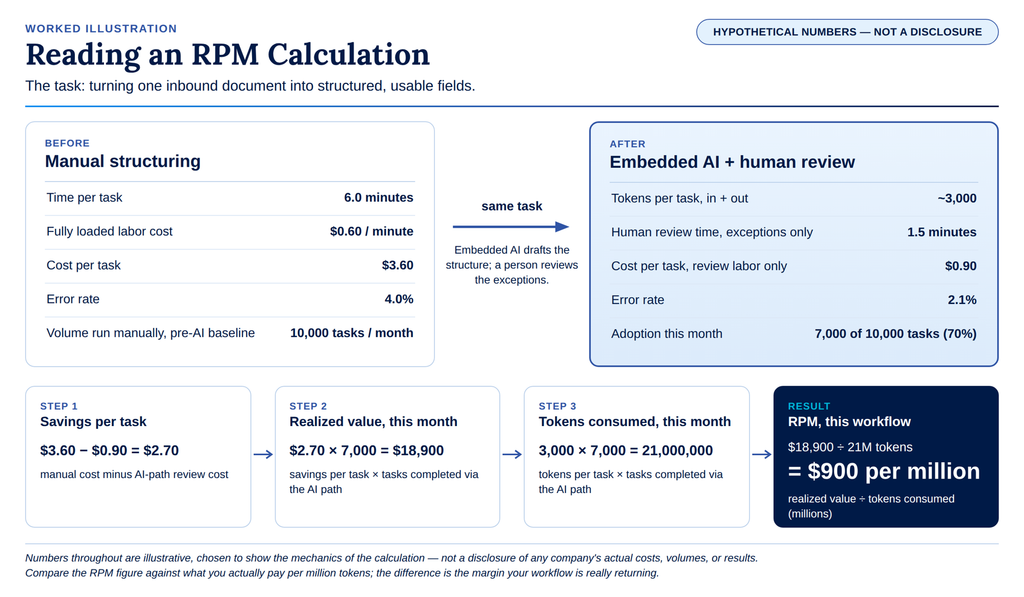
Quality delta against baseline. Error and rework rates measured against the pre-AI process, on the same sample. If quality isn’t measured, the unit cost is fiction.
Adoption rate, the asset-turn ratio of AI. A brilliant unit cost at 8% adoption is a plant running one shift. We track the share of eligible work actually flowing through the AI path, and we treat low turns as seriously as high costs.
Realized versus avoided cost. Realized means dollars that left the P&L or capacity redeployed to named work. Avoided means a projection. We count realized. We footnote avoided.
What we refuse to count. Vague productivity multipliers. Survey-based time savings. Anything that cannot survive an audit.
The hurdle rate. AI spend must clear the same discipline as any other allocation of capital. There are no blank-check ‘strategic’ exemptions; too often, strategic is what people say when the math doesn’t work. An important distinction: metered token usage generally remains operating expense for accounting purposes, even when the evaluation capabilities built around it create multi-year economic learning. Without disciplined measurement, it is simply expense with an uncertain return.
Two perspectives, one team
Fernando: This is where Doug and I actually disagree, so we may as well have the argument in front of you. Doug’s default bar is in-year payback, and for embedded workflow automation, I believe he’s right. Those cases should pay for themselves roughly inside the fiscal year or die at their termination date. But evaluation infrastructure and data foundations are multi-year assets by nature. Force them through an in-year filter and they often won’t get built, and subsequent projects will cost more because you didn’t.
Doug: My answer is that Fernando is right about the assets. However, the resolution isn’t a softer bar. It’s two buckets with two payback periods and one authority to terminate. The speculative bucket gets a multi-year clock and a hard size limit. The committed bucket gets an in-year clock and no mercy. What we don’t allow is the blend, where everything is “foundational” and nothing ever pays back.
What does RPM look like in practice for us? At Claritev, our document-intelligence workflows are measured at cost per claim processed against a manual baseline, with quality measured alongside economics. That is how an argument about value becomes auditable, rather than inferred from activity.
Figure 4 | One workflow, one month, measured.
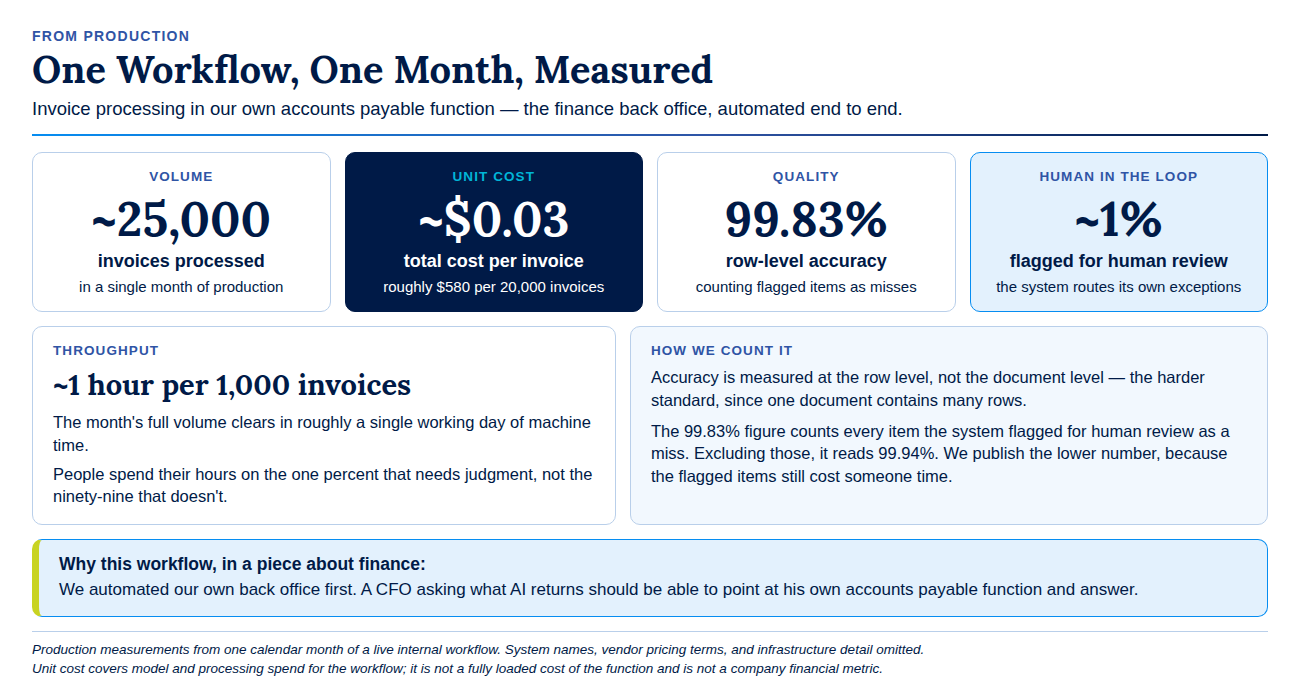
Opportunity stops being a vision statement when it has a unit of account.
PART FOUR | Prove and Adapt
The worked example: bounded, checkable, and human-supervised
We’ve described the machinery in general terms because we believe it is transferable. Here is how the selection discipline looks inside one company, ours. It is an illustration, not a prescription.
Healthcare administration runs on documents, so documents are where much of our AI work concentrates. We turn unstructured clinical documents into structured data under a deliberately strict rule — the system may record only facts it can point to in the source, and when the source is silent, so is the system. We help human coders check their work rather than replacing their judgment. And we generate plain-language explanations of administrative outcomes that often arrive as cryptic codes, so readers can act rather than decode.
Notice that all three examples share the properties Part Two said to look for: bounded input, checkable output, recoverable error, and a human on the exceptions. That overlap is intentional. It’s how we decide what to take on in the first place.
Responsible AI as engineering
“In healthcare, responsible AI should not be a values statement. Instead, it should be a set of requirements that show up in the build.”
Fernando schwartz, ph.d., Chief ai Officer | Claritev
At Claritev, a human reviews AI output wherever determinations are involved, full stop. Provenance and citation are product requirements; output that cannot point to its source does not ship. Guardrails for protected health information are architectural, not merely procedural. Production models carry documentation of what it does, what it was evaluated on, and where it fails.
We also do this work in the public realm. Through the Coalition for Health AI (CHAI), we have contributed to responsible-AI framework development alongside health systems, researchers, and patient advocates. That engagement reflects why practical standards matter. Our own test remains concrete: provenance, citation, and human review remain standard features of what we ship.
The future of finance and AI
AI does not change the CFO’s core function. They remain the company’s primary capital allocator. What changes is the tempo of the decision cycle required to fund the business.
For most of my career, capital allocation meant methodically underwriting projects: estimate the return, debate the assumptions, make the bets, then revisit the bets months, quarters or even years later.
AI compresses that cycle immensely.
Forecasts change faster. Capabilities get cheaper. Competitive advantages decay sooner. The question is no longer only, ‘Is this a good investment?’ It is, ‘What is this risk worth right now, and what are we willing to pay to preserve the ability to change our mind?’
That makes optionality a central finance problem to resolve with the business and P&L owners.
The best investments may not be the ones with the highest static ROI. They may be the ones that let us learn faster, redirect capital sooner, and exit cheaply when the facts change.
The CFO’s role does not move away from capital allocation. It becomes a more active version: continuously pricing risk, uncertainty, and optionality, and redirecting capital as information changes.
Fernando: A shift is also happening in AI. My job becomes less about building a particular model and more about developing the organization’s capacity to change direction at low cost: the pods, the partners, the evaluation infrastructure, and the discipline to stop when necessary.
Doug: Exactly. Fernando is building the optionality. Finance must still price it, fund it, and manage it.
The answer
So: opportunity or threat?
Companies treating AI as a threat and companies treating it as an opportunity can fail for the same reason: they invest without changing how decisions get made.
The winners in AI won’t be the companies that consume the most intelligence. They’ll be the ones that know what that intelligence is worth and have the discipline to move capital the moment the economics change.

Doug Garis
Chief Financial Officer, Claritev

Fernando Schwartz, Ph.D.
Chief AI Officer, Claritev
Sources
1. VandeHei, Jim, and Mike Allen. “Behind the Curtain: A white-collar bloodbath.” Axios, May 28, 2025. https://www.axios.com/2025/05/28/ai-jobs-white-collar-unemployment-anthropic
2. Murdoch, Scott. “OpenAI’s Altman says AI unlikely to lead to ‘jobs apocalypse.’” Reuters, May 26, 2026. https://www.investing.com/news/economy-news/openais-altman-says-ai-unlikely-to-lead-to-jobs-apocalypse-4708791
3. Rogelberg, Sasha. “Sam Altman and Dario Amodei are both walking back their AI jobs apocalypse prophecies as they eye blockbuster IPOs.” Fortune, May 26, 2026. https://fortune.com/2026/05/26/sam-altman-dario-amodei-walking-back-ai-jobs-apocalypse-prophecies-ipo/
4. Yale Budget Lab. “Tracking the impact of AI on the labor market.” Oct. 14, 2026. https://budgetlab.yale.edu/research/tracking-impact-ai-labor-market
5. Jacobs, Skye. “At Nvidia, compute already costs more than employees. The rest of corporate America is catching up.” TechSpot, April 28, 2026. https://www.techspot.com/news/112209-ai-compute-costs-getting-high-they-starting-rival.html
6. Warren, Tom. “Microsoft starts canceling Claude Code licenses.” The Verge, May 14, 2026. https://www.theverge.com/tech/930447/microsoft-claude-code-discontinued-notepad
7. Janakiram MSV. “Uber burns its 2026 AI budget in four months on Claude Code.” Forbes, May 17, 2026. https://www.forbes.com/sites/janakirammsv/2026/05/17/uber-burns-its-2026-ai-budget-in-four-months-on-claude-code/
Related Content
New ideas, proven best practices, and fresh perspectives for the healthcare ecosystem.
-

Turning Transparency Data Chaos into Reimbursement Intelligence
Transparency data is transforming reimbursement strategy, but only when it can be trusted and applied effectively. Discover how Claritev turns complex pricing data into…
Read More -

Why the Future of Technology Starts with People
Technology alone doesn’t drive innovation. People do. Discover how Claritev’s Technology Leadership Program combines next-generation talent, cross-functional experience, and executive mentorship to develop leaders…
Read More -

The Fountain of Youth in Healthcare is Fostering an Innovation Mindset
What keeps a 45-year-old healthcare company innovative in a rapidly changing market? Learn how strategic investment, operational agility, and actionable insights help organizations navigate…
Read More