Three ways to modernize your COB approach
Traditional Coordination of Benefits (COB) processes are manual and error-prone. Learn how new technologies can help your plan transition from cost recovery to cost avoidance.

Traditional Coordination of Benefits (COB) processes are manual and error-prone. Learn how new technologies can help your plan transition from cost recovery to cost avoidance.

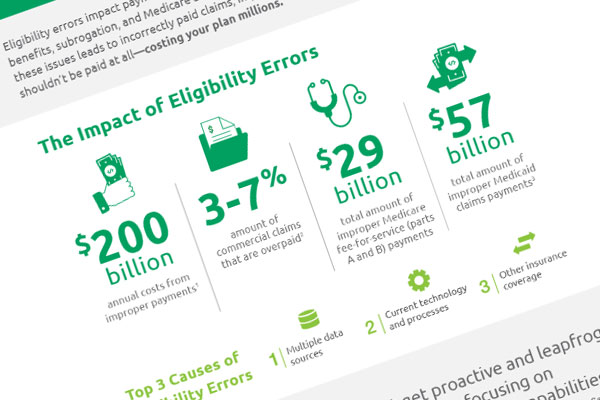
Administrative complexity continues to drive the high level of waste in healthcare threatening the viability of organizations throughout the healthcare ecosystem. With a holistic, connected payment integrity strategy built around these three tenets, your organization can improve operational efficiencies and achieve financial integrity.

Now is the time to evaluate how well your health plan is maximizing recovery opportunities, improving cost avoidance strategies, and exploring premium restoration possibilities. To do this, you need to start at the source of your payment and revenue integrity challenges: eligibility data. Find out how eligibility management and a connected payment integrity approach can strengthen your payment and revenue integrity efforts.

Members with End-Stage Renal Disease (ESRD) account for a disproportionate amount of medical expenses. Learn what you can do by following these five steps to ensure your Medicare Advantage plan doesn’t miss out on millions of medical premiums from the Center for Medicare and Medicaid Services (CMS) for members with End-Stage Renal Disease (ESRD).

What roles are necessary in your healthcare organization for successful application of your data analytics? Whatever the size, culture, and maturity level of your company, there are five key functions your organization needs to develop models that can help drive claims analytics solutions to address real-world problems.

Claritev survey findings highlight a mixed outlook on telehealth as the healthcare industry evolves beyond the pandemic. While many stakeholders recognize telehealth’s convenience and potential for expanded access, challenges related to cost, utilization, and long-term sustainability continue to shape how payors and providers view its future role.

The COVID-19 pandemic has created volatile claim trends for healthcare payors, with declines in elective care offset by sharp increases in telehealth and COVID-related claims. Payors can respond proactively by leveraging data analytics, technology and agile strategies to manage costs, adapt to rapid changes and integrate telehealth into long-term care models.

The COVID-19 crisis created rapid changes in healthcare delivery and billing practices, increasing the risk of inaccuracies and inefficiencies. As new treatment protocols, coding updates, and regulatory shifts emerged, healthcare payors faced heightened pressure to detect errors, maintain compliance, and ensure payment accuracy in an evolving environment.

Healthcare payers face constant pressure to control costs in an increasingly complex and fast-moving environment. Success depends on three critical attributes: customization, flexibility, and speed to market. By tailoring solutions to unique organizational needs, remaining agile in response to change, and rapidly deploying effective strategies, payers can better manage costs while maintaining accuracy, efficiency, and member satisfaction. [claritev.com]