Rethinking Payment Integrity: Why Prevention Is a Strategic Advantage




Since payment integrity vendors first started working with healthcare payers, success has been determined by dollars recovered. While recovered dollars make sense as a measurement of success because of the very fact that they can be measured, this practice may not be the best strategy for payers.
The High-Cost of Recovery
First, recovery dollars aren’t a true representation of money the payer recoups. This is because there is a cost to every dollar recovered that needs to be subtracted from the recovery amount. These costs can include:
- Time and effort expended to identify and then recover inaccurate payments
- Provider and member abrasion that recoveries can create
- Possible disputes and reconsiderations from providers
- Potential vendor fees
- Administrative work required to document the recovery
There’s also the possibility that despite identifying an inappropriate payment, it may not be able to be recovered.
Prevention Is More Valuable Than Recovery
So while seeing recovery figures can be briefly reassuring, they don’t tell the whole story. The real success of a payment integrity program should be measured by its ability to stop improper payments from happening in the first place.
Everest Group research shows that pre-payment (overpayment prevention) approaches deliver higher ROI than post-payment recovery by enabling cost avoidance and reducing downstream administrative burden. Supporting this, vendor research shows that shifting from reactive appeals to proactive prevention can deliver significantly higher returns—often 3–5× ROI—while traditional appeals recover only a portion of denied amounts and require substantial administrative effort. This is because prevention stops improper payments before they occur, avoiding the additional effort required for rework and appeals, which do not guarantee full recovery.
What to Look for in a Pre-Pay Payment Integrity Program
When implementing a pre-pay payment integrity program, payment integrity leaders should consider the following.
- Types of edits identified. Programs that rely solely on automated, industry‑standard edits can catch clear-cut, black‑and‑white errors, but they may miss more complex or contextual issues that require clinical or analytical review.
- Risk of provider abrasion. Technology‑only approaches, especially those attempting to move beyond basic edits, can generate false positives. This may lead to provider friction, increased inquiries, and payment disputes.
- Impact on claim processing times. Understand how much time the program adds to the overall adjudication workflow. Could the additional review jeopardize compliance with prompt‑pay requirements?
- Flexibility and growth of edits. A strong program should not rely solely on static rules. It should continuously expand and refine the types of issues it detects based on emerging patterns, payer policies, provider behaviors, and regulatory or industry changes.
- Capability to score claims for likelihood of error. Does the program include predictive analytics or scoring models that help prioritize which claims warrant deeper review?
- Detection of anomalous provider billing behavior. Beyond claim‑level issues, effective programs should identify patterns at the provider, billing group, or member level, including unusual or suspicious billing trends.
Ultimately, a strong pre‑pay payment integrity program should balance accuracy, speed, and provider relationships to drive sustainable cost containment.
Clarity in Action
Going forward, payment integrity leaders should prioritize stopping overpayments before they occur, as prevention can ultimately deliver greater value than recovery. At the same time, not every improper payment can be avoided, making it essential to maintain a balanced payment integrity strategy that pairs strong pre payment controls with targeted post payment solutions to address residual risk.

Award-Winning Payment Integrity Solutions
Claritev has a robust portfolio of pre-pay and post-pay payment integrity solutions. Our pre-pay solutions include Advanced Code Editing, Itemized Bill Review, DRG Validation, and Clinical Negotiations. Together, these solutions combine technology with reviews from physicians and coders to help decrease provider abrasion. They also have the ability to score claims most likely to have errors and detect anomalous behavior and are regularly updated to expand the types of errors they are capable of identifying.
Related Content
New ideas, proven best practices, and fresh perspectives for the healthcare ecosystem.
-
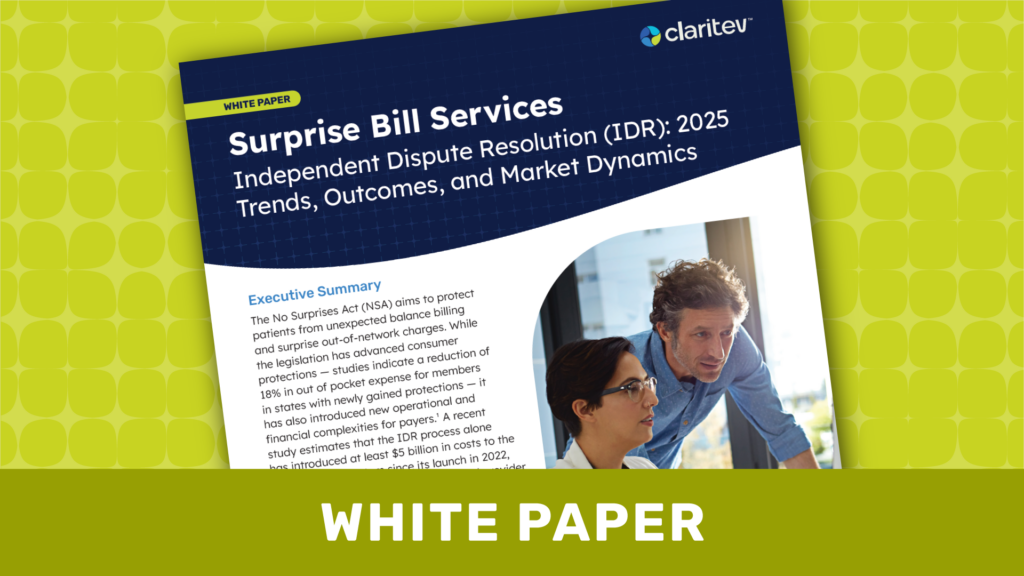
The State of IDR in 2025: Trends, Market Dynamics, and Strategic Insights for Payers
WHITE PAPER The State of IDR in 2025: Trends, Market Dynamics, and Strategic Insights for Payers Navigating rising dispute volume, provider-favored outcomes, and growing…
Read More -
The Next Evolution of Payment Integrity
Move beyond recovering payment errors after they happen. This white paper explores how connected payment integrity, powered by responsible AI and advanced analytics, helps…
Read More -

Why Pre-payment Integrity Matters More Than Ever
Claritev’s recognition as a Leader in Everest Group’s 2026 Pre-payment Integrity Solutions PEAK Matrix® Assessment highlights its decades of expertise helping health plans improve…
Read More