
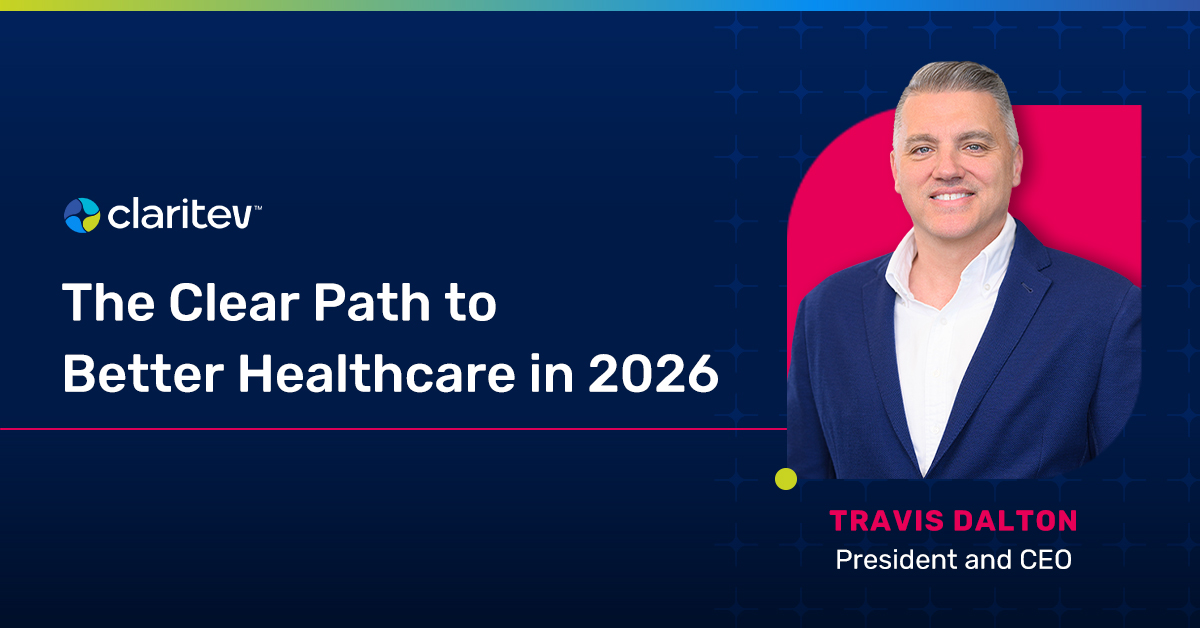
By Travis Dalton, President & CEO, Claritev
Healthcare doesn’t need more noise in 2026. It needs clarity – and the courage to work across a system that’s too often fragmented.
As we step into the new year, it’s clear that healthcare is at an inflection point with very real challenges in front of us. Rising costs are squeezing families, employers, providers, and payers. Evolving regulations and workforce pressures are reshaping how care is delivered and supported.
Yet, amid the complexity, there is opportunity. I remain optimistic, because the resolve to tackle these problems echoes through each conversation I have — with our team, our clients, and our partners. The opportunity is real. But where should leaders focus their energy to make meaningful impact?
1. Rising Costs Need Transparent Solutions
Costs continue to climb, not only for patients but for employers, providers, and payers who are all navigating an increasingly complicated system. But we can’t cost-cut our way to better healthcare. We must reduce waste, eliminate avoidable friction, and help make sure that high-quality care is also an affordable choice.
That starts with transparency. When stakeholders know what care costs, why it costs what it does, and where variation reflects value versus noise, better decisions follow. Transparency enables accountability, smarter contracting, and outcomes that support both patients and the long-term viability of healthcare organizations.
2. Clarity is Essential in a Complex Regulatory Environment
Regulation is meant to protect patients and strengthen trust. Managing the impact of policy shifts and implementation timelines is increasingly difficult. Slowing down is not an option. The time to act is now.
The path forward is anchored in clearer information, stronger workflows, and data-driven insights that allow organizations to act decisively. In this environment of shifting rules and reimbursement models, the ability to interpret change quickly — and respond at scale — will separate those who adapt from those who fall behind.
3. Sustaining a Strong Workforce as a Competitive Advantage
Talent retention strategies cannot be ignored. According to a recent workforce report, attrition could have a huge financial impact on US employers in 2026 — to the tune of over a trillion dollars.
All employers must take a more holistic view of how they support their people — from financial benefits and wellness programs to the tools teams rely on every day. This is where technology can be leveraged as a workforce multiplier. AI-driven capabilities aren’t about replacing people – they empower teams to move faster and free up capacity for higher-value work. This is especially critical in healthcare, where every role in the ecosystem matters.
4. Supporting Health Equity and Access, Starting in Rural Communities
Rural hospitals and clinics are fighting to keep their doors open, navigating new policy and reimbursement realities while striving to keep care accessible. But access to quality care should never depend on a ZIP code.
The industry must pair policy advocacy with practical solutions. Simpler payment models, more sustainable networks, and better data can help rural providers plan, contract, and deliver care with confidence. Closing these gaps quickly isn’t optional; it’s critical to the health of our rural communities and the system as a whole.
Clarity in Action
To meet these challenges, we must lean into innovation and a shared commitment to progress. Driving data transparency and embracing AI responsibly across the industry will unlock new ways to deliver value and support better decision-making.
No single organization can solve this alone. But those across the industry can design and adopt solutions that put patients at the center and turn complexity into momentum.
If we stay committed, 2026 can be the year healthcare moves forward with clarity, confidence, and purpose.
